In a previous post, I set out a mini-law and I promised examples to come. As a reminder,
Docthib’s tiny law: « If, for a given product or service, you are looking for a more sustainable or respectful alternative*, while demanding the same level of quality as before, then you are not a true activist. «
* In the sense of sustainable development, sustainability, or respect for personal data and privacy.
My first example is an obvious one: Amazon. These days, most people shop online on this site. It’s quick, cheap and there’s a huge choice. When I was young (in the second half of the 20th century), there were still drugstores in every neighbourhood: nearby your apartment, you could find stain removers, cleaning gloves and basins, paint or bicarbonate, hardware, light bulbs…
Amazon has replaced all that, and any small-to-large DIY store will swoon with envy (or jealousy) at the choice offered by this online site. Now, real-life sales assistants tell me that customers come to ask for advice, take a photo of the product with their phone, and finally buy it on Amazon.
But this company is neither sustainable nor environmentally friendly, and it treats its employees and suppliers badly – not to mention collecting personal data from consumers whenever they shop. Amazon doesn’t pay taxes, fires unionised employees, and sends tens of thousands of new products to landfill every year.
What alternatives have I been using now for several years ?
My first solution is Fnac–Darty (a French company). This company pays its taxes, has real shops with real shop assistants, plenty of choice on the shelves (while avoiding cheap electronics from producers zillions of miles away), and there are no controversies over this company – or at least, much less than those over its almighty competitor.
This is a fact that the products sold by Fnac are often a little more expensive than those of its aforementioned competitor – but not always. And for online purchases, their delivery times can also be a few days longer.
This brings us to two additions to the tiny law above :
price is not everything ;
the notion of comfort.
Price isn’t everything, because for a company that pays no tax, and even no social charges in some countries, it’s easy to have lower prices. So let’s try to replace the current discourse. Instead of saying » Amazon offers the best price « , let’s say » Amazon refuses to ensure the safety of its employees, and refuses to pay its contribution to society « . Do we want to encourage this system when we personally pay tax and we benefit from social protection? In other words : when I pay a little less for a product sold by Amazon, I am encouraging a fraudulent and unethical company.
Let’s talk now about comfort, with the example of my alternative when purchasing books (I read a lot). Amazon may be the biggest bookstore in the world, but in comparison :
The shelves in each Fnac shop are very full, so you can compare, read a whole chapter, browse in some strange sections in the library, and therefore discover, taste, see, smell…
Local bookshops, although smaller, can order any book, with delivery usually arriving the next day. And all this comes with a personalised advice from the sales assistant.
There’s some much pleasure in diverting from one’s path for a few minutes, to stroll the shelves of a bookshop, or even talk to a human being about the comparative merits of two authors or learn about the bestsellers of the month.
My third source of alternatives, apart from books or products that Fnac sells, is a little folder in my browser that I’ve called » Achat-zone » (in French, standing for Shop-Zone. But the French wording actually resembles the name of the company that should not be named). Achat-zone is my anti-Amazon. It is a folder in my personal toolbar in Firefox, and I regularly update it with all the French websites and products that I regularly use but can’t easily find in store , like clothes from a French brand, household products or useful supplies…
Of course, this means online purchases with delivery that takes a little longer than with Amazon. But I’d rather give (indirectly) my money to La Poste (French mail company), which dispatches my parcels, than contribute to the hellish stress and work insecurity of Amazon’s delivery drivers.
Let’s come back to this notion of comfort, or giving up a certain level of comfort. The impulse to buy from Amazon is often encouraged by the promise that the product will be delivered very quickly – but in all candidness: is my life going to change because this product is delivered on Tuesday rather than Friday ? In these times of instantaneous gratification, it’s always nice to experience patience, to measure the passage of time, and to understand that an order + delivery must take a certain amount of time, just because there are human beings at the other end of the supply chain. At worst, when I’m told that certain delivery times will be » long » (10 days! How inconvenient! As if some people were stalling right next to their letterbox this whole time), I can always question the purchase : « After all, do I really need this product ? »
So let me amend slightly my tiny law, to add the dimension of comfort, or the voluntary choice to accept a reduction in comfort :
Docthib’s tiny law: « If, for a given product or service, you seek a more sustainable or respectful alternative*, while demanding the same level of quality or comfort as before, then you are not a true activist. «
* In the sense of sustainable development, sustainability, or respect for personal data and privacy.
At a time when many people are making their New Year’s resolutions, and perhaps just as many are deciding to stop making such resolutions (“new year’s resolutions are like a cheque drawn on a bank in which you have no account”, Oscar Wilde), I am trying to keep a resolution I made almost one year ago, i.e. to start a series of blog posts on a new theme. As usual, I don’t know how often these blog posts will be published, or how extensive the list will be: it’s the beginnings that are the most beautiful, or at any rate, the most exciting.
So what are we going to talk about? It all starts with an aphorism I concocted around March 2024, which goes like this:
Docthib’s tiny law:“If, for a given product or service, you are looking for a more sustainable or respectful* alternative, while at the same time demanding the same level of quality or confort as before, then you are not a true activist.”
sustainable in the sense of sustainable development, sustainability; respectful, in the sense of respectful of the environment or respecting your privacy / personal data.
This aphorism doesn’t come out of nowhere, nor is it purely theoretical: it stems from my personal experiences and observations, with examples that are sometimes important, sometimes trivial, but nonetheless relating to many different fields. And I suspect this law could become a motto for many people.
In the coming weeks, I will be developing these examples. In the meantime, you can question yourself: how does this aphorism speak to you? In other words, to what field / tool / product could you apply this law?
Inspired by the example of my esteemed colleague Benjamin Voyer, I did the following experiment: ask ChatGPT to write my biography, Wikipedia style. Like Ben Voyer, I was also very surprised by the result.
As regards form, it is perfect. It also shows that language doesn’t matter: the same query, in French or in English, gives exactly the same text. In other words, ChatGPT seems to have an internal language, understood only by him/her, which serves as a common basis for responses in different languages.
However, the substance is a different matter. The following table gives a visual understanding of what I mean:
To build up on my esteemed colleague’s analysis, it’s not as if this information were hard to find: the vast majority of it is public, present on many sites, and even if I’m not present on wikipedia (quite normal, IMO), there is clearly enough public data to write a proper wikipedia entry.
With such a list of errors, it is surprising that ChatGPT has correctly identified my field of activity. The Augur in Information (AI) says « French economist and finance professor »: I’m not an economist, but hey, it’s at least reassuring not to have been classified as a « Youtube influencer » or « septic tank drainer ».
As a conclusion to this little exercise, a fundamental observation: while ChatGPT can be very accurate (and helpful) when asked pragmatic questions – for example about how to use an Excel function – it is not the same when it comes to news or people. It is not a search engine, it is a conversational assistant. In short, don’t be surprised if it tells you fairy tales…
PS: I suggest you do this experiment on your own name. You can even publish the result on social networks with the hashtag #ChatGepetto, we’ll see whether this starts a trend…
TotalEnergies has just published a record profit of 14 billion euros. What about the expected dividend (more than half of the profit)? In a business that is 90% based on the exploitation of fossil fuels, where are the investments to limit climate change or externalities?
Those are excerpts from a detailed analysis (in French) on my blog (limited section in English here) – contrasting classical finance and sustainability, and taking not only figures in their absolute amounts, but showing also orders of magnitude.
Let’s put on our green glasses and look at the situation of TotalEnergies from the point of view of sustainable finance. If this company decides to pay a large dividend to shareholders, this means that they can do without the money. In other words, they feel that their investment needs are amply covered.
Please refrain from smoking
Now, let’s broaden the notion of investment to encompass projects that meet any of the United Nations’ 17 Sustainable Development Goals, or ESG (environment, social, governance) criteria. The question becomes: has TotalEnergies planned enough sustainable investments? Indeed, this company could decide to invest massively – in proportion, not only in amount – in environmental policies: reduction of exploration – especially in the Arctic – and exploitation of fossil resources, major investment in truly renewable energies (not counting gas, then…)
Another way would be to further develop the letter S in ESG – more inclusion and diversity, better parity in decision-making bodies, respect for local populations in exploitation areas. Finally, G for Governance: it is always good to increase the transparency of executive remuneration methods, the independence of board members – why not invite an NGO such as Reclaim Finance to the board? – and the rejection of local corruption practices.
These sustainable investments could be extremely profitable in the medium to long term. Of course, in the short term, they would lower the risk-return trade-off, one of the pillars of traditional finance. Indeed, capital expenditures would probably reduce profitability in the short term. But if these investments contribute to a likewise reduction in the risks of the corporation (climate risks, local risks, reputational risk, lower attractiveness of the company as an employer, etc.), the risk-return ratio might benefit from that change.
We could also leave behind the classic two-dimension risk-profitability trade-off and introduce a third dimension, with a risk-profitability-sustainability tripod. The question would no longer be to maximise profitability for a given level of risk, but rather to optimise the three components of the tripod. Some companies would still continue to give priority to profitability, but at least, their stand would be clear: “We choose to ignore sustainability issues in order to maximise profitability.” Shareholders would then react accordingly: the maximisers (following the risk-profitability trade-off) would all be in favour of this move, while the optimisers (tripod) would take the high road.
TotalEnergies – the heavyweight of the French CAC 40 Index and one of the seven “supermajor” oil companies – has been attracting increasing attention for years. Indeed, it has a few blemishes on its record: 30 years of actively challenging climate change, financing authoritarian regimes, and intensive and aggressive exploration of natural environments that ought to be protected. At the same time, this company is among the best rated in its sector on ESG criteria. Some portfolio managers go so far as to say that TotalEnergies is the greenest of the oil stocks – please appreciate the oxymoron.
Where does such a paradox come from? On the one hand, we know that fossil fuel producers are major contributors to greenhouse gas (GHG) emissions… But on the other hand, an investor will want to know which companies are the most virtuous in a given sector. TotalEnergies is “relatively” well-ranked within its sector.
Finally, there is perhaps a deeper reason for the focus on this group: even today, cities are designed for and around cars; the car, or the SUV, is still, for many, a synonym of social status; logistics are still massively based on road transport (“if you bought it, a truck brought it”), or airplane delivery. Oil is therefore still a commodity of first necessity (but for how long?).
Let’s illustrate this with the yellow vests protests in France. The initial measure that triggered this movement was an increase in the carbon tax in the price of gasoline. Paradoxically, carbon tax is one of the means to reduce the effects of climate change (polluter pays principle).
Gulping gallons
Our relationship to oil is therefore complex, particularly in its human aspects: even though many of us are aware of the climate and biodiversity issues facing our planet, it is more difficult to take action when it impacts on our consumption habits or our leisure activities. TotalEnergies might be on a dark path, but this also reflects the dark side of our own choices.
Let us conclude on a positive note. Admittedly, TotalEnergies is not spending enough on ESG criteria, in comparison to its enormous amounts of GHG emissions (reminder: when communicating on their emissions, most companies « forget » scope 3 – which represents upstream and downstream emissions from their products, for example when they are used by customers. This scope 3 is enormous for TotalEnergies: 400 Megatons of CO2 equivalents, i.e. 90% of total emissions). In absolute terms, if this company were to devote just 1% of its revenues to ESG issues – and we are talking about more than 2 billion dollars here – it would be good publicity, much better than the “greenwashing” campaigns that such companies now regularly bombard us with.
This blog post is part of a series of reflections on the Coronavirus / Covid-19 crisis and the transition I had to operate from my face-to-face courses to online classes.
Fellow professors, look no further: here is the ultimate combination (in my opinion) for teaching online from your computer. For less than a hundred euros (see budget details below), you can regain much of the fluidity of the face-to-face classroom, while still enjoying the benefits of distance learning.
The advantages of the face-to-face course are well known:
better interaction with the students, thanks to a greater proximity.
greater fluidity in the change of medium (Powerpoint, questions-answers, whiteboard…) In two previous posts (here and there), I showed that a simple situation in the classroom (answering a question by writing on the whiteboard) corresponds, in the online world, to a succession of at least half a dozen actions – with the corresponding lag.
Here are some advantages of online courses over their face-to-face counterparts:
« Sam, can you unmute your microphone? »
The online course is done on a computer connected to the Internet. It therefore allows the use of a number of collaborative tools or platforms, for example:
shared documents on which students can work collectively and in real time (e.g. Google Docs, or Padlet), with the possibility of downloading the final document at the end of the session. In comparison, in the classroom, some students take pictures of the whiteboard, which is less practical and less ‘portable’ (in the sense of being easily re-integrated into another medium).
the possibility of accessing all kinds of resources such as videos or images much more quickly than in the classroom. Indeed, in the classroom, the teacher is above all a human being: if he wants to show a video, he has to go to the computer, load the page, check that the sound is correctly transmitted to speakers, etc. In contrast, the online teacher is in an exoskeleton, which is her computer. Everything goes through the computer: the teacher’s face, her voice, and litterally every other resource that you can find on the Internet. Indeed, there is only one teaching channel, which is video with sound. In the same way that a railway can carry passengers as well as helium or cows, here the computer can transmit both the teacher’s messages and other resources.
Dedicated tools can be used to make certain sequences more dynamic and faster. The most telling example is probably that of voting with instant results (Klaxoon, Wooclap) or quizzes (Kahoot). In a classroom, you have to ask for a show of hands, count the votes, take into account the reluctance to vote (impostor syndrome). All of these limitations are overcome online, resulting in faster and more comprehensive results.
Two major disadvantages of distance learning
Lack of fluidity
Anyone who has tried to share a document in Zoom will understand what I mean by « lack of fluidity ». There is always a lag time, and this is amplified when you have to juggle several documents. For example, in Zoom, it often happens that you have to switch between a Powerpoint presentation and the Zoom whiteboard – especially to illustrate concepts. If you add a third document (e.g. a text, a spreadsheet), each change will further reduce the fluidity. Not to mention the questions, which force you to go back to a previous document: cancel the current share + share the old document = a lot of time spent on manipulations.
Dehumanisation
« Whatcha doin? »
On the student side, many leave their cameras off, which confronts us with black screens. But on the professors’ side, it’s not very human either, when the students only see a slide show with a « voice-over » commenting from afar. I challenge my colleagues to pay attention to a slide that doesn’t move for 10 minutes, while someone (sometimes without seeing their face) comments on the important points, before moving on to another slide and another commentary. This problem is combined with the first problem of fluidity: to restore a minimum of dynamism, it should be possible to change media quickly (e.g. switch to the professor’s face on full screen). But the screen-sharing manipulation does not allow for quick switching back and forth between documents.
The ultimate combination: a broadcast software + a second webcam
Mid January 2021, I was lucky enough to discover this article (in French) on The Conversation France, and since then, I’ve been able to refine the method described in its first tip. But a quick (and dirty) video speaks more than words:
Quick video to demonstrate the Open Broadcast Studio software
The budget = 99€.
Studio at home
The camera costs 74€; I count 4 coloured markers at 5€; this leaves 20€ to contribute to the OBS project while staying under 100€ (there is a mistake in the video: the initial donation was 25€, thus bringing the budget a little above 100€). Indeed, it is an open source project whose product (the Open Broadcast Studio program) is free and without advertising. In this case, it seems to me legitimate to make a financial contribution on this page, which allows to pay either for the project or for Jim, the full-time developer/contributor. It would even seem fair to me that institutions contribute as well, given the great interest of OBS. By institutions, I mean universities, colleges, business schools like the one I work in, online education companies…
As usual, all comments and reactions are more than welcome !
This blog post is part of a series of reflections on the Coronavirus / Covid-19 crisis and the transition I had to operate from my face-to-face courses to online classes.
Never before have students cheated as much as at the end of this semester of study. The lockdown meant that final exams had to be held remotely, which obviously allowed for widespread cheating. Although many universities require students to sign a declaration of honour, this did not prevent an unusual amount of cheating. This raises the question of the motivation for cheating in the first place. The traditional reasons – i.e. outside of containment – are either unpreparedness or a taste for dangerous play, with cheating seen as a moral shortcut. But in these times of pandemic, we have sees that « non-cheating » students opted this time for cheating, in order to improve their grades. Indeed, in many countries, potential employers ask for details of grades obtained in studies before recruiting. Some students fear that their grades « during lockdown / online classes » are too low for their future employment, or that they will not be able to enter certain specialisation courses. This is exacerbated by the fact that in some courses, professors seem to be unaware of the constraints of distance learning, and they require their students to cram of a lot of knowledge in their heads in a very limited time (i.e. during the semester). In this case, we are not talking any more about learning, the right word being: force-feeding.
This blog post does not seek to understand – let alone excuse – cheating behaviour online, but rather to reflect on ways to avoid cheating in online exams.
Know your audience(s) / market segments 😉
The final exam confronts different populations whose interests are not necessarily aligned.
First, there are the cheaters, who are not necessarily a homogeneous population, as indicated in the motivations given above.
Then there are the non-cheaters, who should not be penalised by anti-fraud strategies. Indeed, the fact of multiplying controls (camera surveillance, firewalls to prevent access to certain sites) automatically leads to technological roadblocks / deadends. As a result, a bona fide student may be penalised by a surveillance system that prevents him or her from taking the exam in good conditions.
One must also think about the proctors (assistants in charge of monitoring the students during the exam): they are officially in charge of checking that participants do not cheat, but their capacity to act is limited. Indeed, they can see that student X was helped by someone who appeared in the camera field; on the contrary, it is impossible to say what student Y was looking at on her screen: was it the exam, or a Whatsapp discussion of a cheating group?
Finally, there is the designer of the online exam, who has his own constraints, and who has to make optimization choices (which we will detail in the following paragraphs).
My 4 golden rules of a good online exam
Here is my magic recipe, or moral compass, for the professor in charge of designing an online exam. Those laws follow a path analogous to the 3 laws of pedagogy. These 4 laws for exams (online or in-class) would be, by decreasing order of importance:
Non-cheating students must not suffer from the anti-cheating system;
Cheating students must be prevented, or severely restricted, in their ability to cheat, without contravening Law #1;
The exam must be easy for the teacher to grade, without contravening Law #1 or #2;
Finally, without contravening Laws #1, #2 and #3, the role of proctors should become incidental. Ideally, there would be no need to proctor / watch the students taking the exam. It is a bit like the notion of strong efficiency in financial markets: in a properly designed examination, it should not matter whether a student can communicate with other people to cheat, because in doing so, they would not gain any more advantage than by doing the work alone.
The main tension: time vs. personnalization
For the person designing an exam, one important variable is time. This is not only the time to design and test the exam beforehand, but also the time to grade the exam afterwards.
At one extreme of this tension is the MCQ (multiple-choice test): for a preparation time that is not too long, the final grading time is very short. This is ideal for the lecturer who does not want to spend too much time on designing and grading the exam.
At the other end of the spectrum, we find the exam with open-ended questions that require an essay from the student. The term essay is broad: it is not just « do you think that Man is good? », it can also be « given the situation presented above, say what you would recommend ». In this case, it takes time to design the exam, but probably less than in the case of a MCQ – one only have to find generic incisive questions. As a counterpart, the grading/ marking will require to read carefully everything the student has written, even reading between the lines. Indeed, even if the student has not necessarily used an important keyword, they may nevertheless have understood the notion, and only a fine analysis of their answer will allow to judge whether the notion is mastered or just learnt by heart without a real understanding. In this second case, the grading / feedback is therefore extremely personalised, as the student really allows us to « get inside his/her head » and see how they think.
This issue of time vs. personalisation will therefore become crucial for many professors when it comes to designing an exam.
We also have conflicts of interest concerning the time that the professor is ready to spend on exams. Let’s take the example of students who failed the exam: in most institutions, this leads to a resit exam. This resit exam therefore represents extra work for the teacher, and this represents an additional time for which the professor is usually not paid. So the professor will have to design a second exam for a handful of students, but they would not have to perform this additional work if all the students have passed the exam i.e. no one failed. Thus, in some cases, the teacher will tend to round up the final exam grades to avoid a resit exam; or they could produce a resit exam that is easy to design, quick to grade, and easy to pass. This question of extra working time is exacerbated because the resit exam might only concern a handful of students: who would want to write a 3-hour resit exam for just one person?
Thoughts and solutions for a an online exam
After these general thoughts, let’s contemplate the different technical solutions for online exams. For the sake of illustration, we will take the BlackBoard integrated examination system, not only because this solution is widespread in the academic world, but also because it offers many possibilities in the construction of online exams.
The wrong solution: MCQs
By MCQs we mean not only multiple-choice questions (MCQs) – with only one possible answer – but also, in general terms, multiple-answers questions (MAQs) – where there are several correct answers to be selected].
Although they appear to be an easy solution, MCQs/MAQs are not a good idea to avoid online cheating, for the reasons detailed below.
Randomizing answers is not a solution
Blackboard allows to shuffle the order of answers within a question, in the hope of reducing communication of answers by some students. But alas, many students type very quickly: when they communicate with each other to exchange correct answers, it takes not much more time to say « answer b. « or « the answer is €12 » or « answer: because of the cost of capital ».
Randomizing questions is not a solution
Blackboard also allows you to mix up the order of the questions, to avoid communication between students. But unfortunately, practice shows us that some students are very organised: instead of asking « what is the answer to question 7 », they ask « what is the answer on oil price? « – so it doesn’t matter that the question is in a different place in the exam. Of course, one can build a very large pool of questions to drown students: for example, 1,000 exam questions, from which the system will randomly draw 100 questions for a given student. But this poses several problems: first, having to write a large number of questions; second, making sure that the questions are of the same level of difficulty and give the same number of points – this is very tedious. The only possibility – which exists – would be not only to put the questions in random order, but also to forbid going back once a question has been answered. But this may contravene law 1: a non-cheating student may wish to go back because question 7 (for example) made him/her think of a better solution for question 3. It would not be fair to prevent them from changing a previous answer.
Most MCQs test knowledge, not ability.
The author of this article has been in confinment with 5 young adults who are studying online. Over weeks, he has then been able to appreciate the assessment systems of different university courses. Most of the time, online exams take the form of MCQs, and most of the time, these MCQs test knowledge, not ability. Professors warn their students: « for the exam, you should know the important dates and the great names of the inventors ». The MCQ thus becomes a test of memorization and speed: for some teachers, proposing 100 questions for 1 hour of examination allows – according to them – to discriminate sufficiently the students. But does this assess their learning, or simply their ability to regurgitate information quickly? Of course, there are courses that require learning by heart (e.g. Anatomy), but these situations are rare: most of the time, courses require students to demonstrate an ability to reason, express themselves and act, and not simply repeat some concepts, like a performing dog act.
There are problems with the scoring of MCQs.
Some courses have a rule that if students have forgotten only one correct answer, they get zero for the whole question. I consider this an aberration. If I tick 3 answers out of the 4 that were right, I should get ¾ of the points, not zero. Otherwise, there will be no discrimination between the student who has worked ¾ of the way through the subject, and the lazy person who has not studied anything – which is deeply unfair. Fortunately, most examination systems offer to give partial marks according to the number of correct answers the student gets. However, the teacher must (1) be aware of this function, and (2) be willing to apply it.
There is also the question of negative points: should a wrong answer reduce the mark for the question? Let’s imagine a question with multiple answers (MAQ): there are 5 possible answers, and the teacher indicates that there « might be » more than one possible answer (without indicating the number of correct answers). If the teacher makes the mistake of not putting negative marks, then the student only has to tick all 5 answers each time: he will be sure to get 100% of the points. So negative marks should be given for wrong answers. But the next question is more complex: how should these negative points be measured? If you tick all 5 answers, should you get a score of 0, an average score (e.g. 2.5/5) or a negative score (which will then penalise the overall score)? Opinions differ, and as is often the case, the absence of a clear-cut answer should help us ponder and reflect on this issue of negative points – and then adapt our exam accordingly.
The answers to an MCQ must be unequivocal.
The MCQ has the advantage of an automated system: read the question, tick one or more answers, be marked automatically accordingly. But it requires questions and answers to be unequivocal. There is no room for nuance, or for finesse in interpretation. It is therefore a rather demanding literary (and logical) exercise to write a ‘good’ MCQ. In practice, I find that even for the simplest and clearest questions, some students really manage to rack their brains out of the most common context. Are they projecting more difficulties than necessary? Are they looking for a hidden trap? Often, behind its apparent operational simplicity, the MCQ underlines that it is really not so simple to test knowledge in a granular way.
Some tips gained from experience
It all starts with the MCQ
The MCQ is not the devil when you look at it in detail. You just have to look beyond the « knowledge test » stage, and try to reach the « test of a skill » stage. Here are some tips from a lot of trial and errors over past years.
Tip 1: forget MCQs and do only MAQs.
Reminder: MCQs offer only one possible answer, whereas MAQs can offer several correct answers. My advice is to turn all MCQs into MAQs – even those with only one correct answer – for several reasons. First, it is not necessary to announce the number of correct answers. If the student is told that there is only one correct answer, he or she can proceed by elimination, or stop thinking as soon as the correct answer is identified, whereas a sentence such as « check all the correct answers » forces the student to really think about each possibility. Second, at least in BlackBoard, MCQs offer « radio button » answers while MAQs offer « check box » answers, which is to the disadvantage of MCQs. Indeed, let’s imagine the following situation: in a MCQ with radio buttons (only one correct answer), the student chooses answer A. But after thinking about it, the student is not sure, and wants to play it safe by not answering this question after all. Well, with radio buttons, it is not possible to un-click an answer: once you have clicked a button (answer A), you can just click another answer (answer B, answer C), but you cannot un-click the whole thing. As a consequence, if a wrong answer causes negative points, then students will choose not to answer questions they are unsure about. But this will only be possible with an MAQ (all boxes can be unchecked) and not with an answered MCQ (once a choice has been chosen, it is not possible to « un-answer » the question).
Tip 2: answers should ideally check for a skill, not only for knowledge.
A MCQ / MAQ quizz is not bad per se. The professor just needs to write the question as a problem to be solved. For example: « You have to make 100 g of white chocolate and 100 g of milk chocolate. You have 200 g of cocoa butter, 100 g of sugar, 100 ml of milk, 200 g of cocoa powder. How much cocoa powder do you have left at the end of the recipe? » In this case, the student’s professional ability is being tested. It is a more subtle assessment than asking them to tick the right recipe between 4 answers. But it does not solve all the cheating problems: once the student has completed the solving process, he/she can communicate the answer quickly (« hey people, the right answer is 75 g of cocoa!! »)
Calculated formulas
This is a variant of the previous question, but with specific calculations for each student. This type of question indeed is generating random numbers. For example, one student will get « you must make 100 g of white chocolate and 100 g of milk chocolate » while another student will have « you must make 70 g of white chocolate and 120 g of milk chocolate », and BlackBoard calculates the correct answer each time. The good point is that it really prevents students from communicating their answers. On the other hand, it only tests the ability to memorise – and then apply – a formula, without judging the ability to interpret the result. Furthermore, it only works with subjects that use formulas or calculations.
Jumbled sentences
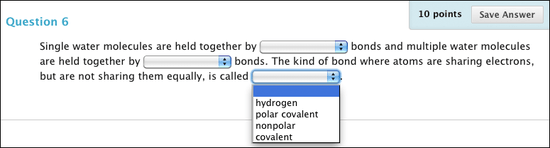
These are my favourite questions. Normally, they serve to check concepts that were learned by heart (e.g. the cubitus is [a bone / a nerve / a gland]), but they can be turned into real skills testing tools.
Tip 1. Avoid fill-in-the-blank fields, use drop-down menus instead.
Some ‘fill-in-the-blank’ sentences offer a text field to be filled in, which means the student has to type the correct answer on the keyboard. This is not advisable, as the software only recognises the words that are declared. For example, if the question is « The early bird catches the… », the professor will have declared « worm » as the correct answer, but perhaps not « Worm » with a capital letter. A typographical error is all that is needed for the answer to be considered incorrect (« wurm »), which is not fair, especially when English is not the student’s native language. So the best solution is to use predefined drop-down menus. The advantage of those is that they offer a list of terms to choose from: no problem with typos, misspelling, or even synonyms (« insect » or « food » instead of « worm »).
Tip 2: The answer should ideally test a skill, instead of pure knowledge.
This is the same reasoning as for the MCQs / MAQs: the professor needs to write the question in the form of a problem to be solved. The bonus here is that the sentence makes it possible to validate a set of notions. If I take the example of financial analysis (one of my courses), the problem will take the following form: « Here are the accounts of a company over the last 5 years. Calculate the return on capital employed (ROCE), break it down, and then find the correct elements in the following sentence.
The sentence then offers gaps with a drop-down list, as in this example: « The operating margin (increases; decreases; remains stable; decreases slightly), and at the same time there is an (increase; decrease; stagnation) of the NWC in days of sales which, in the end, is rather (good; bad; neutral) as far as profitability is concerned ».
This type of sentence therefore requires the student to make calculations AND make a diagnosis with causes, consequences and a value judgement on the situation. An additional advantage is that there can be several sentences: one could even imagine a whole paragraph of diagnosis to be formulated. However, there are some limitations to this tool. For one part, the writing of the blank sentences and, above all, the choice of terms in the drop-down list, must give only one possible solution. Since there must be no room for different interpretations (i.e. different sentences that could all be « right » somehow), this usually leads to fairly simple cases. Nothing prevents the professor from writing more complex sentences, but then he/she has to make sure that there is only one winning combination of the words. Additionnally, this does not totally prevent cheating: once a student has done the calculations, they can pass on the correct sentence to classmates (« The operating margin is increasing, and at the same time the NWC in days of sales is decreasing, which, in the end, is rather good as far as profitability is concerned »)
The 5th Law
All of the solutions mentioned here are interesting, because they not only offer much more possibilities than the « simple » MCQ, but above all, they allow the development of a reflection on what the teacher wants to assess.
Now there is one more important aspect: feedback. Many students want more than a grade, indeed they want to understand what they did well, and what they could have done better. A score on a MCQ is therefore not enough. We come back to the tension between the automation of marking (which suits the teacher), and the personalisation of assessment (which is the legitimate demand of the student). We can therefore add Law n°5: an ideal exam should allow students to learn from their mistakes.
Conclusion
Coming back to the objective – i.e. to prevent cheating while respecting Law 1 – no solution is 100% reliable. Once students can communicate with each other, every evaluation system – however subtle and complex – shows its flaws. And no computer system can cut off all the communication means of remote students among themselves. In other words, although the solutions mentioned have their advantages, none of them can meet the requirements of Law 4, i.e. to have an unsupervised examination. In order to have an unsupervised examination, this would require that the communication of information among students becomes useless. This means that there should be a different examination for each student. This poses obvious time problems, not only the time to design multiple exams, but also the time to grade them. As a matter of fact, there are no economies of scale if the professor is confronted with, say, 25 different exams for 25 students.
Actually, this kind of differentiated assessment (each student having their own specific questions) already exists. This is what we call individual assignments, the ones to be handed in during the semester. One solution could be to forgo final exams: evaluation of the student would be done by continuous assessment, in the form of an individualised control of abilities and skills. If we go in this direction, it would be necessary for the professors – and their institutions – to accept the additional time that this represents in the professor’s work. In other words: if we do not want to give the same task to all the students, we must acknowledge that an individualisation of the evaluations means more time to be allocated on this issue of evaluation.
All those reflections finally boil down to one generic advice: if the university / business school really wants to stick to final examinations, they should realise that no online exam is 100% reliable to avoid cheating. The best solution is to organize in-classroom examinations, with someone on site to ensure that no cheating takes place.
This blog post is part of a series of reflections on the Coronavirus / Covid-19 crisis and the immediate transition from my face-to-face courses to online classes.
At the time of writing of this blog post, there are still uncertainties about the start of the new academic year in European business schools and universities.
The least likely – but not impossible – scenario is a « business as usual » scenario: lecture halls full of students, face-to-face classes, and an open access to school facilities (offices, canteen, library, work rooms).
At the other extreme of logistical conditions is a scenario of a courses as they were delivered during the Covid-19 containement, i.e. 100% online classes, alongside with all the other dimensions of the academic profession (online tutoring of dissertations, meetings by videoconference, and a lot of e-mail exchanges – much much more than under normal operating conditions).
And then comes the 3rd way, or rather, all the intermediate ways, consisting of a weighted cocktail of online lecturing and face-to-face courses – with some students being connected online – as well as digitized pre-requisites, all of those operated in a synchronous or asynchronous manner.
At the time of writing, the dice have not been cast, and no doubt that many schools and universities are currently putting a lot of energy and fever, thinking about the organization of the next semester in September. Now, if we take the point of view of the consumer/customer, i.e. the student, what is education?
In other words, what’s in a diploma? What are the components of that piece of paper that Shakespeare (or Humphrey Bogart) might qualify as being of the stuff that dreams are made of?
So, what does a student or a manager look for in an education? In my opinion, 3 different things:
1. Knowledge: delivered by professors & researchers, but also available in textbooks, or co-constructed during group projects. In those processes, we learn, we understand, we develop reflexes (thought and action). It is thus one of the dimensions of the professor’s work to create a consistent pedagogical path, like a game of hopscotch that alternates activities, strong or weak moments and many different bricks, Lego like: examples, concepts, pitfalls, practical applications, discussions, anecdotes, references to current world news, presentations, feedback…
2. Brand & Positioning: Part of the value of the diploma is the business school’s or university’s brand. Some people swear by the rankings, even though rankings have the bad taste of not remaining stable over time, and a school’s good grade might be different, depending on the organization or the newspaper that operates the ranking; other people rely on the long-lasting reputation (La Sorbonne…). In this situation, business schools & universities have taken good care of this intangible asset over the years: there are the leader brands, the ones everyone knows; then there are the specialists, who have managed to create a niche: « the best entrepreneurship training West of Berlin », « the first salesforce school »…
3. Collective experience. An education is not just a set of textbooks stamped with a brand (with a price attached…). Students and managers come to live a collective experience, which takes place outside as well as inside the classrooms. This mix of networking, collective projects and mixing of European and extra-European cultures leads to « thicken the sauce ». Graduate cohorts follow one another without being the same: some sauces are more fluid, others are more spicy, and most of them have a unique taste. Nevertheless, it should be noted that many programmes today offer such an electivity of courses and modalities (alternation, gap year, stay abroad) that it is becoming increasingly difficult to talk about the « spirit » of a cohort of students who will graduate on the same day. In fact, within the global cohort, we can see the formation of several sub-groups where the participants know each other and recognize themselves in the same joint experience.
These three components (diploma = knowledge + brand + collective experience) are the pillars of an education in business, and even though the weighting is probably not uniform (1/3 knowledge, 1/3 brand, 1/3 lived experience), it is difficult to estimate the weight of each of the three components in the value of a given diploma.
But it’s all for the real world, i.e. the world of face-to-face classes and one-one-one tutoring in the professor’s office. What happens when you suddenly switch to 100% online training? Let’s look at the impact on these three components:
1. Impact on knowledge. Facilitating a 100% online class creates frustrations and drawbacks: group discussions are harder to start, participation is lower, and the professor has to invest in a lot of online software and new interaction techniques in order to regain the level of a face-to-face classroom experience. The value of the learning path will therefore be downgraded, compared to what could have been done in a face-to-face environment. Our assumption is that a 100% online course will only reach 80% of the quality of a face-to-face course (i.e. a loss of -20% compared to the face-to-face equivalent).
2. Impact on the brand. This component is little affected by the switch to 100% online courses. A brand consists in rankings, a network of successful alumni, and recognition from companies and other organizations. To take an analogy that may be debatable (I’m not a marketing expert), the value of the Wal Mart brand does not depend on the % of sales made in stores versus the % of sales made online. We can therefore assume that the Brand component will keep the same value when switching to 100% online classes.
3. Impact on the collective experience. Ouch, this is where it’s going to get worse. In the case of contained, or at least isolated students, the collective experience will shrink dramatically. You can’t rely on Whatsapp groups or discussion forums to instill the same spirit as when you are in a physical place. And what about extracurricular activities? Student associations, parties, sports challenges, students’ consulting activities are all opportunities to experience « The fiery crucible in which true heroes are forged », in the words of Master Sergeant Farell. We can thus assum that this collective experience value will be strongly degraded by a switch to online classes. Let’s take the hypothesis of a degradation of -70%, which means that when a course is suddenly switched to an online version, the collective experience from such a course will be 30% of its face-to-face equivalent.
In summary, we can write this down as a formula, first for a face-to-face education:
As a result, we get a comparison in terms of value:
V(face-to-face education) > V(online education)
The difference in value between the two modalities is due, as we have seen, for a small part to the lack of fluidity in the transfer of knowledge (loss of -20%), and to a larger extent, to the difficulty or impossibility to replicate a human experience with the same quality as in face-to-face education (loss of -70%).
Some last thoughts
This model – like all models – simplifies reality. But – as with all models – it is through this simplification that we can begin to establish a basis for understanding and reflection. Your comments or suggestions are therefore welcome.
The degradation mentioned here will only take place if there is an abrupt shift from face-to-face training to full-online training. There will be no degradation – at least we hope not – if online training had time to be designed from scratch by taking advantage of the great richness of online learning, including tools that allow you to do things online that you can’t do as well in a face-to-face setting. But in this case, it takes 6 months to a year (at least?) to design this new type of training.
Professors and lecturers have made an important distinction since the very beginning of containment: as noted in the previous blog posts, most of us did not actually do distant learning during the covid-19 crisis. Rather, we switched abruptly to online emergency teaching. This is not the same thing, particularly in terms of value delivered.
This blog post is part of a series of reflections on the Coronavirus / Covid-19 crisis and the immediate transition from my face-to-face courses to online classes.
Don’t do what I do, do what I say
Beware: long blog post. This article started from the following idea: in previous posts, I made up a list of rules and tips as I went along. In the religious register, we could talk about 10 commandments of online teaching. But in Matthew 22:35-40, a doctor of the law asks Jesus which is the greatest commandment. So could we make it boil down to one, generic observation that would encompass all commandments? This is what I tried to do in this reflection, and I came up with the following idea: an online course will exacerbate and amplify the characteristics of a face-to-face course. It will go higher, farther, stronger, to quote Gaston de Coubertin, or – to be more realistic – online means more limited, less interactive, more exhausting.
Starting mid-March 2020, ESCP business school decided to close its Paris campus, both for students and professors. In the space of a weekend, all face-to-face classes were to switch immediately to a 100% online format. Faced with this unprecedented situation, each professor was confronted with an alternative: either try to transpose in an online format the exact equivalent of what was happening in the classroom; or assume that everything had to be reinvented, since an online course is delivered through a totally different medium, with different constraints. We can take two analogies to illustrate this alternative.
300 grams of proteins
The author of these lines is old enough to have lived through military service in France, and during the days spent in the field of operations, each soldier received a survival ration. Thus, in the wild, the soldier would take out from his package a cardboard box containing the equivalent of an airplane meal tray. It would be a mistake to compare the quality of this survival ration to a « normal » meal, e.g. one that could be eaten at a restaurant or at home. Indeed, in military life, one was either on the field of operations with survival rations, or hosted at the barracks with meals in the canteen. A good point of comparison is thus to assess to what extent the survival ration is equivalent to a meal in the privates’ canteen (and not the officers’ mess!). The survival ration was indeed a replicate of a military canteen meal, under the constraints of the field in the wild: no possibility of heating, with limitations to weight and size… As a result, the quality had been degraded in this process, but the result still remained in the category of a military meal. This is the same for pivoting abruptly to online teaching. We are in a situation where we tried to replicate an experience while taking into account the new constraints of the environment, therefore degrading the product.
« Dear impatient debtor… »
In contrast, let’s take a second illustration. The author of these lines is old enough to have known a world before e-mail. A long time ago, people from the Mailing Room would show up every morning at our desk to deliver letters in paper format. We would read it, write the reply or have it typed by our secretary, and the reply would be put in an envelope a few days later and sent by post. When e-mail arrived in France, the majority of users mistakenly thought that it was just a change of format: from a paper letter, we switched to an electronic mail. In fact, this led to a lot of deviant behaviour, because the reality was way more complex. Indeed, we were confronted with a completely new mode of communication that should have invented its own rules instead of copying the rules of paper mail by analogy. If this step had been done, perhaps e-mail would be much more effective in the functioning of organizations as of today. These 2 illustrations can be applied to the switch to online courses. First, there was urgency. The idea of survival ration sets the tone: how to get by in the jungle, all on your own, i.e. deprived of all the usual logistics of barracks and headquarters? Should we opt for a strategy to try and copycat the face-to-face experience – with an imperfect result for sure – or try to reinvent the whole course in this new format – a time-consuming strategy, to say the least. After 2 months of practicing online courses, we can establish a comparison with face-to-face courses, and the differences between both modalities can be summed up in a single generic idea: an online course exacerbates and amplifies the characteristics of a face-to-face course. Let’s unroll those comparisons in the remainder of this article.
Before the class – preparation
The ratio of invisible hours to visible hours
While students are sleeping…
In a typical face-to-face course, we know there is preparation: the professor adapts the structure of the session, prepares documentation and exercises, and reviews the major concepts that he or she wishes to convey both in substance and in form. But in addition to these hours of “classical” preparation, online teaching requires additional hours. Indeed, if one decides to do his or her lecture exactly as he or she used to do in the classroom, the outcome is bound to have a degraded quality: some actions are impossible to perform, such as moving closer to some students; other actions are possible, but with much less fluidity, such as grabbing a marker and writing key words or a diagram on the board. In order to obtain the same results, it is then necessary to plan alternative ways, i.e. search for numerical tools, train and practice with those tools, and design teaching sequences that are specific to the online course. This additional time corresponds to invisible hours: in fact, the only hours visible to the students are the class hours (face-to-face or online), while the hours of preparation are invisible to them. But in the case of an online course, this ratio will be exacerbated. Indeed, for a face-to-face course, let’s assume that it takes one hour of preparation to provide 3 hours of class time; the same course, if done online, will instead require between 3 and 10 hours of preparation for those same 3 hours of class time. The ratio of invisible hours to visible hours is therefore multiplied by 3 to 10 when going online. Those numbers might vary, but the online class will always require much more invisible hours to invest in.
The question of quality
All this extra preparation does not even guarantee that the course will have the same level of quality. The metrics we propose here are much more intuitive than measured, but they give an order of magnitude: if a professor decided to do her online course exactly the way she used to do her face-to-face course, she would probably have a course quality degraded by 40% when compared to the face-to-face experience. In other words, the quality of the online course would be at 60% of the quality of the face-to-face course. For sure, hours of preparation dedicated specifically to the online course will help reduce this gap in quality, but in our experience, they will not cancel it completely. In fact, according to our estimate, the 3 to 10 hours of digital preparation that we mentioned will bring the quality of the online course from 60% to 80-90% of the quality of the face-to-face course. To reach an equivalent level of quality (100%), we would have to invest a lot of extra time on top, or decide that we don’t want to make a clone of the face-to-face class: the online course then becomes another product, another promise, another experience…
During the class
Interacting with black screens
Hello, anybody out there?
One point should be made clear from the outset: in all the online courses we delivered, the students not only muted their microphones (at our request, to avoid background noise), but they also turned off their cameras. In spite of several strategies (e.g. asking to start the class with a round of greetings where each student in turn switches on their camera and microphone to say hello), the students kept their cameras off during whole classes[1]. Even though the professor reminded them that they had 3 ways to react and participate (click on « raise your hand », type in the chat, activate the microphone), the interaction was much weaker than in the classroom. Indeed, in a classroom, a student who does not wish to participate knows some tricks very well: he will keep his eyes down when a question is asked or she will wait for the teacher to focus on some students who point out themselves by their micro movements (nodding, chatting, direct look…). In the case of an online course, each student feels protected by his black screen: he is doubly at a distance – physical distance for sure, but also distant from the senses, since he is literally invisible to the teacher’s eyes…
Transmitting and receiving signals: an energy issue
Those black screens point to our first observation: pivoting to an online course encourages more pure lecturing. As an example, if in face-to-face class, a professor’s performance is a mix of 60% lectures (the professor talks and answers questions) and 40% animations / exercises / discussions, then it is likely that switching to an online course will increase the lecturing part (in our example, from 60% to 80% maybe more), simply because the animation part will be much harder to maintain – because of technical issues for a part, but also because of lower student participation.
Let’s take a break
Another related problem is interaction fatigue. Anyone who has ever taught knows that this activity takes a toll on energy on 3 levels at least: physical energy; mental energy; nervous / emotional energy. This can be partly compensated by energizers: a good atmosphere in a group of students, a successful interaction, stimulating exchanges, all this helps to recharge the professor’s energy battery. If we do now the comparison, we will realize that in an online course, energy drainers will be exacerbated while energizers will be more limited than in face-to-face interaction. Indeed, in a classroom, the professor relies on a multitude of senses: she uses the visual, auditory and kinesthetic channels simultaneously, and she feeds off all these signals to direct the rhythm and allocate her energy. All our colleagues know this: we professors have a form of 6th sense that allows us to detect a drop in attention, increasing boredom, or even realize that we are losing control over what is happening in the classroom… By contrast, when we are in an online course, faced with black screens, we lose a very large part, if not all, of this ability. In addition, even if the students switched their cameras on, this problem would probably not be solved: our mirror neurons feed on all the micro-expressions on the students’ faces, and even though this is done unconsciously, it participates globally in our reception of messages and signals. During a communication by camera, we lose a very large part of these micro signals. Our brain will then try to compensate frantically for this lack of information that it is used to in real life. During this confinement, how many times have we heard colleagues say that a day of videoconferencing meetings tires them much more than a day of face-to-face meetings? Well, the exact same thing happens for an online course…
What about fluidity?
All this done while drinking my coffee
When we are in a classroom, we are used to doing things in an extremely fluid way: starting to answer a student’s question while walking to the whiteboard, grabbing a felt tip pen, starting to draw while talking, grabbing the eraser then rewriting, while at the time, from the corner of our eyes, we check that the student and his classmates are following our reasoning. In comparison, the same sequence in an online course will require juggling different tools, clicking on icons or activating keyboard shortcuts (that we had to memorize), and the fluidity will never be the same as in a classroom. Another disrupter of fluidity is alerts and notifications: in a classroom, when a student raises his hand, he usually does it silently and we automatically record this visual signal without stopping our presentation. Now, let’s imagine that during one of his lectures in the classroom, a professor had to check his e-mails – and answer them on the fly! Each time a new email arrives, an alert sounds, forcing the professor to read the email and then decide whether or not to answer it, while continuing to lecture. It is very likely that this professor would lose a lot of his concentration and thus, his fluidity. This is exactly what happens with online courses: we are explaining a concept by sharing the screen, and we hear a « ding » which means that either a student has raised her hand or someone has posted a message on the chat. In our brain, the « lecturing » zone must go on while the « reading » zone reads the message and the « decision » zone selects the answer to adopt: ignore, process later, answer now… No wonder that the brain can be overwhelmed.
Technology, savior or burden?
In a conventional classroom, technical problems have recurring characteristics. Firstly, these problems are limited to the equipment used: the computer, the video projector and possibly the microphone. Then, when a problem arises, we can rely on dedicated support services. Finally, we always have a plan B, or even a plan C: if our USB key doesn’t work, we can retrieve slides from the cloud; if we really can’t access our slides, we can tell students to follow the class on their paper handouts; in the worst case, we can even improvise a class using only the whiteboard and felt tip pen. In comparison, in an online course, technical problems will be exacerbated alongside those 3 axes. Firstly, an online course generally uses many more tools than just a computer: the video capture platform with document sharing, a drawing software, an online survey application, not to mention shared documents for collaborative work… There is probably a computer law somewhere that postulates that the more tools you use, the greater the likelihood that a technical problem will arise: this is a simple common sense observation. When it comes to troubleshooting, the online professor will then be on his own. This means that the professor now has a double hat: in addition to his historical professor / researcher / animator hat, he now has to put on the outfit of Mario the digital plumber, with a necessity to be really swift, because everything happens live. This implies additional stress, since we are outside our area of expertise, but in the eyes of the participants, we are in charge of restoring good teaching conditions whenever a problem arises. This digital stress will be all the more amplified since there are very rarely plans B in case of technical problems: either the online tools work seamlessly, or we have to abandon a whole section of what was planned when some tools get dysfunctional. As a consequence, we lose a great deal of granularity in our response to technical problems online, and it becomes binary: fix it or lose it.
A modified relationship to time
Be still, my beating heart
In an online course, everything happens more slowly. When the professor asks a question, there is a lag before the question reaches the students (it can take several seconds), then the students have to think it and decide whether they want to answer; if so, then they have to type their answer in the chat or click on “raise your hand”; and once again, there is a time lag before these signals are transmitted to reach the professor’s computer. All in all, between the moment the teacher asks the question and the moment he gets a reaction from the audience, silence looms for a time that is doubled or tripled as compared to the same situation in face-to-face classes. Considering that, in real life, some colleagues already are uncomfortable at waiting for 10-15 seconds before students react, then what about the experience of an online course, when after one of our questions, we have to stare during 20-30 seconds at a black (and silent) screen, waiting for a signal from the Outback.
This warped time also triggers a new relationship to silence, exacerbated by the fact that we are like those blind fishes in the dark depths of the oceans, i.e. very limited in our perception. Let us illustrate that with a typical event: coming back after a break. In the real world, the professor announces a break, and gives a time to be back. When the time is over, she can actually see how many students are back to the classroom. In contrast, in an online course, we usually specify that students should not disconnect their computers, so at the end of the break, we find ourselves staring at those black, silent screens, not knowing whether the students are actually back. One solution is to make a chat call (“please type ‘back’ when you have returned to your computer”). At times, it really feels like we are in a Turing test: the remote correspondent answers us, but we’re not sure whether it is a human being or a chat-bot (i.e. an artificial intelligence programmed to respond to chat messages)!
Scripting, in order to control time and uncertainty
Real-life multi-task improvisation
In the case of an online course, we need to do much more detailed scripting. Indeed, in a face-to-face class, we can rely on our competence as experts in our field, allowing for digressions and improvisations. In other words, we are like jazzmen, relying for a part on their sheet music, but also mastering our instrument so well that we can improvise an exercise on the fly, or set up a situation or an explanation that are contingent to whatever is happening in the room at that moment. Comparatively, and for all the reasons mentioned above, the online course will make us run many more risks when we try to improvise. Teaching online then becomes a strategy for managing – and in this case, minimizing – the risks of a failed experiment.
Here are some metrics that we have observed. In a face-to-face course, a 3-hour session is generally broken down into 3 to 5 parts, with elastic timing: nothing is really written down, it really depends on the interactions with the students, and the key priority is to finish on time, having dealt with all the parts that we had planned. In comparison, a 3-hour online course session is usually scripted with at least fifteen different sequences: instructions on the online tools that will be used, round table to greet each other, a first survey to test the level of knowledge of a concept, then lecture on a concept with 3-4 shared slides, then work in small groups for 10 minutes followed by a collective debriefing, etc. In fact, the same happens in the real world: if an observer were present during a face-to-face class, she would probably identify between 15 and 30 distinct sequences in the 3 hours of the class. But the major difference lies in the scripting: in real life, sequences just happen, some of them being improvised on the fly, whereas in an online course, sequences have to be neatly planned and prepared, with the associated tools (survey application, shared documents, links to videos…), and this requires a much more detailed written script.
We can conclude on a positive note: of course, online courses will exacerbate the characteristics of the classroom courses, but this exacerbation does not always go in a negative direction. Co-teaching, for example, leads to a positive amplification in an online course. Co-teaching in a face-to-face course represents a very pleasant moment of sharing between colleagues, but when it comes to online teaching, doing the course together with a colleague will definitely change a lot of things for the better: we can literally unload some of our burden on our colleague for certain parts of the course; it allows us to work in parallel on side issues (answering the chat, preparing a survey), and students benefit from a live broadcast of the discussion between 2 experts, a bit like when attending a TV show. Not only is it an enriched experience, but it is also an opportunity to consume much less energy than being alone in front of the screen.
After class
After hours
Once a class is over, there are usually many things to do. As for face-to-face courses, this means answering questions by e-mail, posting additional documents or even writing clarifications and guidelines. In the case of online courses, there are at least 2 additional elements that will add service time. First, it will be necessary to retrieve and format the fruit of the students’ work online: whether it is the results of surveys, contributions made in collaborative documents or the structuring of ideas made by the teacher in the form of a mind maps, all the elements that have been produced live during the class must be retrieved, formatted, and delivered electronically to the students. Comparatively speaking, in a face-to-face class, each student is responsible for the notes he decides to take (or not to take), and the professor is not a notes provider. In other words, for a face-to-face class, the professor only needs to write a PowerPoint presentation before the course; in an online course, the professor will need to write two PowerPoint presentations: one before the course, and one after the course. The second service element specific to the online course has to do with time, in the form of asynchronicity. Indeed, while many students will attend the online course live (synchronous), other students can choose to view the recorded video of the course. Some may do this the day after the live session, others may take a week or more before logging in and watching the course. This means that service requests (questions, clarifications…) will take a longer period of time, depending on when the student actually watched the course video.
You are my best Self
Conclusion
We started this article on a tensional question: should we strive to make an online course as a carbon copy of its face-to-face equivalent, or should we instead shift the frame of reference, considering that the online course is a separate product with different codes and expectations? In short, identical twins or siblings? Our angle of analysis has been to show that, from experience, online courses tend to increase / exaggerate / amplify the problems of face-to-face courses. In our opinion, those are really two different mediums that no longer need to be compared point by point, but rather appreciated in their differences. The face-to-face class is similar to a theater play (for lecturing) or a board game (for animation / discussion / experience). The online course finds its analogies rather in a radio show (for lecturing) or in a music festival like Woodstock: the precise planning is decided in advance, the timing is rigorous… and even if we don’t know exactly which technical problems will arise or which pieces the different musicians will play, the performance will be recorded and preserved. After theatre (the 3rd art), rhetoric (the 5th art) or cinema (7th art), will the online courses also become an art in their own right?
[1] Interestingly enough, when the students were sent in small groups to » private rooms « , they would switch their cameras on for each other – and they would switch them off again when regrouped in the whole class.
This blog post is part of a series of reflections on the Coronavirus / Covid-19 crisis and the immediate transition from my face-to-face courses to online classes.
Here is the continuation of my experiments on the abrupt switch of all my classes into an online version. I quickly realized that I had to make a mutation of my whole environment (i.e. get rid of my Doctor Jekyll syndrome and forcefully mutate into Mister Hyde). Here is a list of all the little tricks I have tried to put in place alongside this mutation, including false good ideas and safeguards.
When you are not sure about the substance, work on the form.
Before class
As previously noted, the preparation of an online course requires much more time and attention to detail than the same session of face-to-face classes. To give you an idea, my first « decent » online course consisted in 17 distinct sequences for 3 hours of online session. This means I had a checklist with the 17 different parts of the course, and for some parts I even wrote the outline of my speech. It might sound silly, but when you know from the start that the course is recorded and that the video will be available for later viewing, you are much more concerned about the messages you are going to convey, both in form and substance.
One of my opening speeches at the beginning of the course was: « I’m trying new things ». This very simple sentence actually conveyed several messages:
it gave me justification to have asked for some last minute assignments – even though this should not be done in such ciscumstances, because of the additional stress it can cause;
this contributed to a shared responsibility of reinventing this course, or in other words, the fact that I had a right to make mistakes;
it also helped share my stress on this new experience…
As you might recall, during the Dr. Jekyll period I experienced low participation from online students. So I prepared in advance some conditions for active participation:
I created groups of 5 students arbitrarily. For this I made a mistake. I realize now that I should have followed to the letter the 2nd law of pedagogics online, i.e. sticking to the simplest. Instead, I tried to find funny names for the groups, to get a bonding effect. Not only did this take me quite a long time to find original names (« Sweet Salsa », « Diwali Party », « Bastille Day »…), but in the end, this triggered a disconcerted reaction from one student, who took it as my desire to regroup students according to cultural stereotypes. This required an apology and a rearrangement of the groups – and therefore a big waste of time and energy on the night before class. Since then, I am no longer looking for originality, only efficiency: the groups are called group 1, group 2, group 3…
Once the groups had been formed, I told the students in advance that they would have to answer certain questions during the course: 2 or 3 groups had to work on a course question, for which I shot a small video with one slide explaining what I expected of them. For other groups, I asked to do a search on the Internet and told them that I would ask them for a synthesis during the course. Finally, for some other groups, I warned that I would ask them a question during the live course, and that I would expect them to be contributors. The purpose of all this planning was to avoid cold calling and subsequent awkward silences: they were warned in advance (warm call), so they could prepare themselves. Moreover, the fact of asking the same mission to 2 or 3 groups allowed me to solicit 10 to 15 students for a given task. Given that I currently have about 50% of the students actually present online, and that some of them suffer from « digital timidity », I expecting that out of 10-15 students, there would be at least 2 or 3 who would indeed be participating…
On the morning of the class, I only had to print out the list of groups and names to check which students were actually connected. Then, instead of calling the groups by their number, I called out collectively all the connected students by their first name.
At the beginning of the class
Behind the scenes…
For each course where I meet the students for the first time, I start with a short description of the computer tool (Zoom or Blackboard Collaborate):
the controls they can activate;
access to Chat;
the discipline of turning off the microphone;
asking to talk by raising a virtual hand…
Having done that, I ask each student to say hello in turn.
I call out a first name, asking them to activate their microphone and camera, wave to everyone and say hello.
In the first class where I did this, maybe because of the surprise effect, I had up to 1/3 of the students actually activating their camera; after the surprise effect, in the 2nd class with the same students, I had only 2 out of 27 students activating their camera… There was even a student who asked in the chat if his classmates could make the effort to switch on their camera to say hello – but that didn’t change anything. That said, when you see what a camera accidentally plugged in can do… (caution, explicit video! #teleconference)
In the logic of my mutation into Mr. Hyde, this really raises the question of changes that need to be imposed in order to obtain an online course experience as satisfying as a face-to-face course – even though the elements of each experience would be different. It is a new language, with new tools and new reflexes. And the first reflex when faced with a language you don’t know well… is to stay silent. Having said that, one hypothesis is that the reflexes depend on age or context:
in the majority of companies that experience online meetings, the courtesy rule (most often imposed…) is that everyone should have their camera on.
This may be due to the work context, but from my initial feedback, I see that it is also a question of age: Executive MBAs (whose average age is around 40) all activate their camera during a course, whereas Master students (average age = 23) do not.
Screen sharing
As I experienced during my first week online, sharing of the screen and/or documents has to be as fluid as possible. Here are a few ideas and tricks that I have tried, with varying degrees of success:
It’s a real plus to be able to use pencils to highlight some parts on a slide or to write / draw on the screen.
Some applications, such as Zoom, allow you to use a drawing toolbar above any shared screen – Blackboard Collaborate allows this too, but with far fewer tools. Also, in Blackboard Collaborate, this might cause delays (lag), so that when you say « this is here that the problem lies », students take 3 seconds to see the arrow you have drawn, like a movie where subtitles are not synchronized with the dialogs.
An alternative is to share a Powerpoint slideshow and activate the pencil in Powerpoint to draw directly on the slide (Ctrl-P for Pen, Ctrl-E for Erase, or, with a touch screen, just tap the screen to see a small pop-up menu that displays the pencil or eraser).
You can also use another software dedicated to note-taking and drawing: I’ve been using OneNote for years in amphitheaters where it was not possible to read the whiteboard from the last row, and this works like a charm online.
For all these tricks, it is even better to have a touch screen and a pen (or even a Wacom tablet, but not too small – for me, the A4 /Legal format is comfortable). With those tools, you will gain precision in your handwriting / drawing.
When it comes to document or screen sharing per se, most visio applications (Zoom, BB Collaborate) only allow you to share one document at a time. This means that when you want to change documents, you have to cancel the sharing of the first document, before you share another screen. However, the thumbnails of open documents are not always refreshed in Blackboard Collaborate, which means that several documents (especially PPT slideshows) are displayed with the same image: you have to pick a document at random, praying that it is the one you want, and by the law of the buttered toast, you often end up sharing the wrong document, so you have to start again and take another pick at random… So I opted for 2 alternative systems:
Firstly, I use different formats for documents. One of my slide deck will be in PPT format, and will therefore be opened in PowerPoint; while another deck of slides will have been exported in PDF format, and will therefore be opened in a separate PDF reader; finally, if I need some static images, I have made screenshots of those in advance, and I open them either in an image viewer or in OneNote. Of course, this leads to having several applications open at the same time, with the memory problems that can arise. But at least, with this solution, each document is easily identifiable, and sharing is much smoother, since all applications are already open.
Secondly, I open 2 or 3 different browsers: Google Chrome – which is not my favorite browser, but the one that Blackboard Collaborate works best with; Firefox for my online polling application (Wooclap), with the administrator’s rights; Opera, for the same Wooclap application, but this time to get what the students see on the screen. The alternative solution of having a single browser with multiple tabs open is less convenient:
within the same browser, you cannot be « logged in » and « anonymous » at the same time – unless you use a plugin, if there is such plugin;
navigation between tabs is not as easy as between applications – you have to learn one more keyboard shortcut – if there is such a keyboard shortcut.
These 2 alternative systems allow to switch very quickly from one application to another (Alt-Tab on Windows, Command-Tab on Mac) and so, to make a discerning choice on which screen to share.
Some of my colleagues use a 3rd solution: a 2nd computer or a tablet next to the main computer, to display the « student side » in parallel.
Tentative conclusion
This requires indeed a lot more concentration. Manipulations are numerous, you have to follow a complex pedagogical thread, and you must have an eye on everything. Here are two anecdotes from my last week:
Since I use a lot of keyboard shortcuts, I sometimes trigger new unexpected events on the computer, like exotic Apps that are launched, obfuscating my screen.
At one point, a student raised his hand, and I told him to unmute his microphone and speak… I waited… Then told him that we could not hear him… And waited again. After fumbling with my controls, I realized that I had accidentally muted my speakers, and everyone could hear him but me… So I put my speaker icon on display on my screen, and now I regularly check it.
Chat can be a challenging tool also. Whenever students are chatting, there is visual sign on the screen, and even though I choose not to look at the Chat immediately (but only after having finished my explanation), the brain is a fickly thing and I am sure that I am not 100% concentrated anymore. Those are distractions in an environement that requires a lot of concentration…
Considering all those improvements and changes, my classes went reasonably well. Indeed , compared to the first « Dr. Jekyll style » courses, the changes I made to my online teaching style seem to have paid off:
students participated significantly more, almost reaching the level of a face-to-face session.
The Chat allowed some students who were more elusive to express themselves at length without having to participate orally. Some students also used the Chat to pass on humorous reactions about a concept or the arguments of a fellow student, all with excellent wit (cohesive humour, rather than aggressive mockery).
I see this as a reward for my own efforts – duly publicized to the participants 😉 – but still with an efficiency ratio to discuss. Indeed, it takes me several hours more work than for a face-to-face course… just to get back to about the same level of participation.
Finally, this is still a work in progress, each week bringing its own little batch of improvements – and many new uncertainties.
“You start a question, and it’s like starting a stone. You sit quietly on the top of a hill; and away the stone goes, starting others…”
This blog post is part of a series of reflections on the Corona virus crisis and the immediate transition from my face-to-face courses to online classes.
The professor from the 19th century dealing with a 21st century class…
After general thoughts, let’s move on to a field report. Last week, I had the opportunity to test different online teaching setups. I will talk more specifically about 2 experiences, the first one and what I learned from it, and the last one, with all the modifications I tried to put in place to alleviate the initial disappointments.
This post will cover the first experience, or the Dr. Jekyll effect.
Some background: this course was a course shared with one of my colleagues. She was in charge of the first half (1h30), then I took over for the second half (1h30). My part consisted in debriefing a case that the students had previously handed in. This meant showing a few of their cases and commenting on them.
Before the class A classical (face to face) needs preparation, of course. An online course takes even more preparation, in at least 3 distinct directions that can take a lot of time.
First and foremost, there is the technological aspect. I had opted for a solution that was both simple (to follow the 2nd law of pedagogics) and ambitious, because it required juggling between several applications: Zoom with screen sharing, and Google documents. The first piece of advice I could give is to really do some training « like in real life » before the class. This allows to discover things that afterwards seem obvious, such as taking the precaution of opening all the necessary documents before the course, so that screen sharing can be done immediately, without having to wait for a given application to be launched, or a document being loaded.
Communication with students. According to my first law of pedagogics, I had resolved to maintain regular communication with the students. As a matter of fact, there was no need to push in this direction: the implementation of the online course required many types of interactions with the students before the course even started:
To begin with, a few informative e-mails indicating the solutions I had chosen and the links to attend and communicate (the link to my Zoom room where the course would take place; the link to the question sheet shared from Google documents; answers to questions on logistics).
I also shot a small 2-minute video showing how to use Zoom from the student’s side, and giving some instructions for the class – for example, that all students mute their microphones to avoid noises in the background (reminder: almost all students are in confinement in apartments shared with other people, and possibly young children or animals…). It was also a test to see how easy it is to shoot a short video with Zoom => yes, it is easy, and it allows to relocate part of the content « outside of class ».
Finally, I proposed to do a « trial run » two days before the course, i.e. a session of 15 minutes to test the technological solutions. Here again, and even if only 4 students were present, this session was very beneficial in bringing out the problems that can arise in a real situation.
In retrospect, I see several beneficial effects from this abundance of communication. On a basic level, it sends the message that I am working for my students, and that they are not being left alone in this situation. On a less obvious level, it prepares the students for the online course experience, by giving them a few things in advance of what is going to happen (written communication of questions, sharing documents with online annotation…). And finally, maybe it can create a sense of committment, by convincing students to really attend the online course, instead of passively waiting for the recorded session for deferred viewing. In other words, it helps to make them a little less « passive listeners » and a little more « actors in their learning ».
Coordination with colleagues. In the case of an online course, there is a lot of hidden time that does not necessarily appear as such. The coordination with my colleague for our 2 classes required several exchanges by email, phone calls and a Zoom training session. Once again, as obvious as it may appear, there’s a huge difference between intellectual knowledge (« you’ll see, Zoom is like Skype »), and the simulation of a course session (for example, thinking about launching the recording of the session 😉 ).
During class
This first experience was the opportunity to experience several discomforts.
The key discomfort was to realize that during an online class, everything becomes extremely slow. Juggling between different activities adds each time a small amount of latency (« lag »), with the corresponding stress building up. What one does naturally in a physical classroom, without even thinking about it, requires much more concentration when doing an onlinecourse.
For example, while displaying slides, you can grab a felt tip pen at any time and begin write on the board. Online, this means that you have to activate the annotation bar (lag), then choose whether you are going to type a text or draw, because it is not the same tool (lag), then click on the chosen tool, then draw on the slide above your text (lag), then select the eraser to erase the drawing (lag), then select the mouse arrow to return to the slide scroll mode (lag). Of course, in such a complex sequence, there are a lot of mishaps and idle times… In several occasions, I found myself scribbling on a slide when I wanted in fact to scroll to the next slide. So [select eraser], [delete], [select arrow], [scroll slide]…
And yet, those are simple manipulations. Comparatively, it will take an even longer time to share a given document on the screen. In these cases, one of the lessons I have learned is to choose when (not to) apply the advice that radio hosts know: avoid silence on the air (« dead air ») at all costs. Indeed, when we fumble with controls or wait for a document to appear, we all tend to repeat the same words and excuses over and over again: « You’re going to have to wait a bit… », « Ah, it takes a while to load… », « Sorry, my computer is slow… ». In fact, it’s an attempt to fill the silence, without conveying any real information. So I suggest two alternative strategies:
Silence. Please avoid try to fill the silence. Take advantage of this situation to breathe. Tell yourself that everyone has earned this silent break, both the teacher who stops talking for a moment, and the students who can relax for a while. A short sentence such as « take a deep breath while you wait » can even explicitly signal that it’s a mini-break.
Moving into metacommunication. A strategy not to be used systematically, as it requires a minimum of preparation. This consists in commenting on the situation. For example, « as you can see, it takes time to load. Then again, you will often have the role to conduct meetings remotely. So my question is: which solutions would you use to avoid the discomfort of this waiting time and/or to continue to motivate your listeners? « It can also be « use this moment to take stock of what we have just said. If you had to summarize in a few key ideas what we’ve been talking about for the last 20 minutes, what would you write?«
There’s also what I call the double lag.
First, there is the technological lag: between the moment I draw on the screen and the moment it is displayed on the student’s screen, there is a lag that depends on the quality of our respective Internet connections and the power of our respective processors. This means that when I ask a question, it can take no less than 3 seconds, and often more, before the students actually hear it.
And there is also the human lag. In a real-life classroom, when I ask a question, there is always a silence that follows. Indeed, the students have to process the question to understand it; then they mentally look for answers they might give; finally they decide whether they are going to participate to share their ideas, and if the answer is yes, then they start thinking about the form of their oral participation. All this takes time, which might depend on the students’ brain speed, but all in all, it is never negligible. That being said, even when this happens in a classroom, not all professors have the same reaction to silence. In my classes on pedagogy, I use the MBTI (Myers-Briggs) model to show that lecturers generally have a type of teaching that corresponds to their own personality type. For example, if we take the first axis of the MBTI model, type E professors will tend to expect a quick reaction from their students. Once they have asked a question, they have their perception of relative time, and they will begin to feel discomfort as soon as silence lasts more than a few seconds: they will thus tend to react quickly, either by asking the question again, or by rephrasing or cold calling a given student – who might still be in his/her thinking process.
Now, in an online class, there is the cumulative effect of this double lag. Things take more time: even a simple conversation back and forth (« Are you okay? », « Yes, I’m okay! « ) takes a longer time online than in real life. So when it comes to more complex issues, with the effect of the double lag, it is better to learn to slow down real-life reflexes, to breathe, to get used to silence… This can lead to an « old and wise man » effect which is not bad. The students can feel that the rhythm becomes more relaxed, more reflective, and less oriented towards a dialogue in the form of a verbal ping-pong…
The loneliness of the black screen. Online, most (and, in my experience, all) students turn off their cameras. So this leads to teaching black screens. You can’t tell whether the student is nodding his head, if she’s taking notes in a concentrated way, if he’s very busy with a parallel discussion through e-mail, or even whether she has left the room… This leads to moments of loneliness, when we call Jim who had typed a question and we all wait for Jim to unmute his microphone… or to come back into the room eventually. When this is combined with a low use of the Chat by students, it feels like talking to an empty room.
All of this leads to a lot of stress and a lot of consumed energy. Compared to a face-to-face course (which is already a tiring experience, on a physical, emotional and mental level), an online course requires to send out a lot more energy, and to exercise a lot more control – while having, comparatively speaking, a lot less feedback. In this first course, for example:
less than half of the students were connected
the Google docs sheet intended to receive the questions remained empty throughout the class
Chat was not used often, and when used, it showed its limits: when I ask a question, students think (double lag) and they want to type their answer quickly… at the expense of clarity! So I had some answers that were really difficult to use as inputs:
on the one hand, you want to praise the student who took the trouble to write and interact (positive reinforcement);
on the other hand, the message may not be understandable, or it may mean several different things. In short, it is a downgraded communication that can lead to frustration on both sides.
In my case, the demand for energy and concentration was further increased by the fact that this course is given in English, which is not my mother tongue… And even though I think I have a good level in English (at least enough to have delivered classes in this language for years), the online transition adds a difficulty because of all the unplanned elements. Let’s take an analogy.
Let’s imagine that we tell a French manager that he’s going to have to make a presentation in English. So he prepares for it, he writes out his speech elements, the visual aids, and most often he repeats the speech in front of his mirror, he might even be timing his speaking time until he feels ready and in control.
Now let’s imagine that the same manager is told that he will have to conduct a « fire and evacuation » drill in English. He doesn’t necessarily know the technical terms, because he is no fireman; he doesn’t know what will happen, who will interupt and when, or the nature of the questions that will be asked; he doesn’t especially have expertise in « fire evacuations ». In this second case, the experience of communicating in English will be much more demanding, both in terms of energy and concentration that are required.
To sum up, I felt like the nice Dr. Jekyll, used to an already well-controlled and comfortable life, who said to himself, « Even if I don’t know this new part of town at all, I just have to behave as usual ». Well, it’s not enough. It’s not enough at all. Hence the fatigue and frustration that came from this first experience in the form of a baptism of fire.
In the next blog post, we will see my next classes, and my progressive mutation into Mister Hyde… (work in progress 😉 )
“Here then, as I lay down the pen and proceed to seal up my confession, I bring the life of that unhappy Henry Jekyll to an end.”
This blog post is part of a series of reflections on the Corona virus crisis and the immediate transition from my face-to-face courses to online classes.
Updated job title, same pay, but… new outfit!
Here is the report of some experiments I have done in the past few days, with the corresponding links. To use again the idea of Magnetic North that I mentioned in an earlier post, I applied the equivalent of Isaac Asimov‘s 3 laws of robotics. For my readers who don’t know about these, those 3 laws are interlocked
The first law is the one with the highest priority;
the second law has a slightly lower priority, and is only applied as long as it doesn’t violate the first law;
the 3rd law has the weakest priority: it is only enforced if it does not violate the 1st or 2nd law.
I have therefore established my 3 pedagogical laws according to this scheme.
The first law is: « take care of my students »;
the second law is « accept that courses are in degraded mode »;
the 3rd law is « use collective intelligence ».
Here we go with descriptions and experiments.
First law (priority over the others): take care of my students.
Communicate on a regular basis. Following the announcement of stage 3 in France, I sent several collective emails to my students. In accordance with what I said in the blog post on communication, the main idea was to inform my students that they had a contact person available if they needed help.
Conduct a survey. I realized very quickly that the technological solutions mentioned by my school (especially the digital team), or on the Internet (especially on Twitter, with the hashtag #CovidCampus) were solutions that assumed that the students had an advanced digital environment. However, between the closure of the school premises – where there is Wifi everywhere and we have dedicated and comfortable workspaces – and the return to their home countries, I needed to know what the working environment of my students was. So I sent them an online survey to learn more about their hardware + Internet setup, to check whether they had already had online courses, and to find out what their needs might be for the next sessions. Fortunately (thanks to the 3rd Law), I was able to use an online survey that an American Professor had designed and shared (link here). It was also interesting for statistical purposes: for students that I had already encountered in real life in class, just under 50% of the students responded to the survey, and only 20% answered questions that required slightly more detailed answers (for example, expressing their personal needs); on the other hand, for those courses in which I had not yet met the students in real life, the response rate dropped to less than 25%. Although the sample is not statistically significant, having had face-to-face courses might increase digital engagement when moving to an online course.
React quickly. In the needs expressed by my students, there were concerns about different aspects of the course: would there be an online presence/absence check? How to organize for group assignments? How to ask questions during an online course? Was it possible to avoid using the whiteboard in the classroom, as it was not legible on video (this was before the announcement of total confinement in France)? For all these general questions, I sent emails with adapted rules. For special requests, I used individual emails.
Show adaptability and imagination. Here’s an example that amused me in its different layers of complexity: several students worried about the poor quality of the work they would have to hand in by Monday. Indeed, due to travels home or other mishaps stemming from the coronavirus crisis, they could not communicate as smoothly as before with their work group, so they were anxious about the poor grade they might get. My first response was to say that this assignment would not be graded, because the most important thing was not to get a grade, but to learn… Then I thought of the opposite case: a group of students who had been working for weeks to deliver professional quality work. How would these students take the last minute announcement that their work would not be graded, and their efforts unpaid? So I opted for a slightly more complex proposal: all groups had to hand in their work by the deadline, regardless of the level of completeness, but each group had the possibility to request individually that their case not be graded (even though I promised to give them a detailed feedback). One can go very far in imagining all possible scenarios. Suppose a group had asked to be graded, and then got a bad mark: how should we deal with this siuation, compared to a group that chose not to be graded, and whose average grade would not suffer from the last assignment’s quality?
The answer lies in the application of the 2nd law: avoid complicating things, deal with each situation as it comes up, instead of trying to foresee everything at the beginning (theory of incomplete contracts) .
2nd law to be applied (only if it does not violate the first one): accept that the course will be in degraded mode.
KISS (keep it simple and stupid). Telling myself that the online course will not be as interesting as a face-to-face course was ultimately quite liberating: it’s not about striving for perfection, but aiming for a minimum of efficiency. This can be done in a few very simple steps.
Rely on the tools I already know. Rather than investing time in reading, judging, and self-training on new tools, I prefer to capitalize on the solutions and environments I already know. And whenever possible, by aiming at technological frugality: not all students necessarily have access to a webcam or a broadband connection that allows video broadcasting. For example, recording a PowerPoint presentation with an audio commentary will end up in a degraded version of a lecture that has the advantage of being very light to transfer (even though it is probably dreadfully boring to follow…).
Reasoning in terms of piling up bricks. Following Maslow’s hierachy of needs, it is only once the basic needs are met (here, being able to display slides with an oral comment) that one can worry about adding more things. Here is my indicative pile of bricks to date, starting from the basic need and only moving up when the previous level is secured:
scrolling through slides with an oral commentary
give students the opportunity to ask questions live (for example, in writing in a shared Google drive document or – more complex – a chat utility or – more complex – an oral interruption)
have an online whiteboard solution to be able to draw or type text
…
…
Allow students to vote live on issues (e.g. with Wooclap or Klaxoon).
Allow students to group together from time to time in small virtual workrooms before returning to the collective digital « amphitheatre ».
Back to basics. For me, the seminal question is pedagogical, not technological. It’s a question of very quickly identifying the key messages that you absolutely want to get across during a course session. Moving to an online course will require adapting resources to ensure that these key messages are actually conveyed. In other words, we follow the logic of Mies van der Rohe, less is more.
The 3rd law (only to the extent that it does not contradict the first 2 laws): use collective intelligence.
I see 3 sources of collective intelligence: my colleagues; my students; the Internet.
My colleagues. The digital department of my school has quickly set up training in face-to-face or with distance learning, and this has helped enormously to spread knowledge about our digital tools. At the same time, we exchanged a lot of e-mails on the mailing list of all the professors. This allowed me to notice that there are a lot of profiles with a lot of different pedagogical needs within the school (school in the broadest sense, since we have several thousands of external lecturers…) Faced with this great diversity of questions, I realized very quickly that appealing to collective intelligence would most of the time contradict the 2nd law (go for simplicity).
My students. With the survey that I sent, I was able to collect some opinions from them, but not really advices on how to do an online class. Except for one student who suggested that I do the lectures with a touch tablet, I only received contributions focused on questions, not suggestions for solutions. I also opened a shared Google drive sheet, so that students could ask questions before class. To date, no questions have been asked. My conclusion is that here too, we cannot expect too much in terms of collective intelligence. In the long run, it will be worthwhile to come back to the respective roles of each one and their respective commitment. I summarize my views by deliberately exaggerating: in an extremely controlled course, where the professor announces strict rules of the game and a pre-set framework, it is not enought to have a Coronavirus crisis and an empowerment message (« do not hesitate to take charge and organize collective solutions among yourselves ») to change the behaviors established since the beginning of the semester. Our economy of attention very easily becomes an economy of passivity.
Internet. Praise be given to Twitter, which has made it possible to federate the individual efforts of hundreds of higher education professors around the world. Using the hashtags #CovidCampus, #CovidCampusFr, #PivotToOnline or #PivotOnline has saved me precious time by reading the advice posted by professors who were faced with the same questions as I was. It also made me realize that I really had to keep on track with the 2nd law: indeed, driven by their pedagogical enthusiasm, and most often, by years of investment in setting up online courses, most teachers were suggesting tools and solutions that would require several weeks – maybe months – of design and self-training before one could effectively deliver an online course session. Besides, not all universities have made the same technological choices: Moodle or Blackboard, Microsoft Teams or Collaborate, Google drive or Dropbox?
In short, the resources available online allowed me to learn very quickly about the possible options, but it was the filter of the 2nd Law that allowed me to avoid getting drowned in solutions that were too costly in terms of time and/or energy. Once again, the pedagogical quest has priority over technological tools. This is why, paradoxically, I chose to put collective intelligence as the 3rd priority…
That’s about where I am right now. What about you? Do you have any advice or comments?
This blog post is part of a series of reflections on the Corona virus crisis and the immediate transition from my face-to-face courses to online classes.
It has been announced yesterday night: France has just reached stage 3 of the Coronavirus pandemic. After the announcement by my school of the closure of the premises for all students (all courses are now switched online), we are now moving to a situation of national containment.
When shift hits the fan…
This means even more social distancing, and that justifies a post on the adaptation of communication. As with the previous post, I am interested in any reactions or suggestions.
In this situation of social confinement, communication is going to be very much through e-mail. So here are the few solutions and rules I have put in place in the last 48 hours. Most of these solutions are inspired by my « e-mail management » course.
Manage the incoming flow. I have set up an automatic reply message to any email I receive. Here is this message, if you ever want to use/edit it for your own purpose:
Considering the Coronavirus crisis and the closure of ESCP Business School campuses for students, I am working on switching all my courses online. This extra workload is huge.
As a consequence, please note that I will not answer all my emails, and if I do, this will be with longer delays than normal.
Manage the backlog. It was necessary to take into account all the people who had sent me e-mails in the last days or weeks, and to whom I had not yet replied. So I wrote a message based on the concept of e-mail bankruptcy. Here is this message, if you ever want to use/edit it for your own purpose:
This is a generic message in response to an email you sent me in the last few days/weeks.
The situation is now going to be complicated for me, since due to the Coronavirus crisis, ESCP Business School is closed to students starting Monday morning. So I have to transform all my courses into an online equivalent – with all the additional investment that this represents, and all the losses in quality that can be expected. This means that in an already very busy schedule, I have to prioritise the fact that the course hours are guaranteed, but in a totally different format. In other words, I’ve gone into « crisis management » mode.
If your request was important and can’t wait (you are the sole judge), do not hesitate to send me a new email with your precise request. Otherwise, please contact me again when the situation is stabilized. NB: I do not wish to break off the communication. If you want to contact me, do not hesitate, but please note that I will not be able to answer all messages.
Keep in touch with my students. In reference to what I have previously called my first magnetic north on my moral compass, I try to send one message per day to my students, in order to partly compensate for social distancing and to maintain a group spirit around our school values. As regards substance, these messages are mostly informative, to indicate the progression of my reflections and the decisions I have been led to make in the past hours. In terms of form, I always try to include 3 elements in my messages:
A positive state of mind, which I summed up with the slogan « Keep Calm and Carry On », whose story I have always found fascinating. As far as I am concerned, and given my personality type (MBTI/Enneagram), this state of mind includes humour and empathy, based on our common values.
Every time I announce a change in the rules of the course, it always goes in the same direction: alleviate the pressure. For example, extending the deadline for submitting a case; what was compulsory being now optional; reducing the expectations on a given assignment; announcing that a case will not be graded in the end, but that each student will get feedback.
Finally, as far as possible, I indicate that I am open to any requests or concerns, and that students can contact me at any time.
What about yourself? Would you have any advice on the topic of communication in times of confinement?
Today I am starting a sequence of reflections on e-learning, following the Coronavirus crisis. Indeed, even if to date the French government has not yet taken a position on the shutting out of universities and grandes écoles, I prefer to anticipate, even if only mentally, on how I am going to move my face-to-face courses to online classes. I will use these posts to document, like a log book of a journey, the progress of my thoughts. Context is extremely important here: it is not a reflection carried out in advance to design a future distant course. We are in the middle of a crisis, my school may close overnight, and I would have to transform all my face-to-face courses into a 100% online equivalent with 24 hours notice… Thus I wish to share my reflections as a work in progress, and I hope to receive suggestions, comments, and sharing of experiences on this subject.
Before talking about the practicalities, it seems important to me to define a few fundamental principles that will serve to guide my choices.
In the moral compass that I set for myself, there will be a double magnetic north:
My top priority will be to take (even greater) care of my students. This crisis is extremely difficult for them, knowing that the majority of my students are non-French. We have a lot of Italian, Chinese, Indian, German students, and so on. These students are far from their families, they are housed in Paris or the surrounding area, in (basic) student accommodation. In a normal situation, they are already very often in need of advice and support (and it is an important part of my profession to answer those questions). If my school were to close and their only contact became the online courses they would have to take, it would require even more listening, understanding and adaptability from my part.
The 2nd magnetic north that will guide me is the conviction that a rapid transition from a face-to-face class to an online course can only result in degraded conditions. My current courses were not designed to be taught online, and if some people think that it is enough to have a film shooting of themselves teaching, they clearly demonstrate their incompetence on the subject of online courses. IMHO, the mistake comes from the vocabulary used: I see a lot of business schools talking about immediately switching to online classes. If I had to find an image, it wouldn’t be the image of the switch, which makes it seem as if you just flip a button to change the modalities, but rather the image of the machine translation. A machine translation allows us to quickly get a text in another language, but the speed has a negative counterpart: the product that is delivered is a (very?) degraded version of the original text. This can be used to understand the general meaning, but without the quality and subtleties of the original text.
Before moving on, I would like to specify 2 personal things:
As far as online teaching is concerned, I was not born yesterday. I have designed several courses that were intended from the very beginning to be 100% online, some of them even being totally self-supported (i.e. my role was limited to moderating the discussion forums, answering students’ questions by e-mail, and grading the final exam – zero hours in teaching). I also had the chance to collaborate in writing pedagogical videos, I lead a pedagogy seminar in the school’s doctoral program, and for more than 2 years, I have participated with pleasure in pedagogy co-development groups, where we regularly work on online teaching issues in different programs. So it’s not like I’m discovering the subject today (even though there are people who are far experienced on this topic…) But I persist: switching overnight to a 100% online course will automatically result in a downgraded product.
On the other hand, all this thinking and planning comes as an unexpected addition to a rather busy agenda. I have 2 books I’m working on for my publisher, a research article to modify, a magazine to publish, one or 2 conferences to organize, a son in internship and a daughter who is going to take the French Baccalaureate… So my posts will probably be short and badly written 🙂 (remember : it’s a log book).
Now let’s get to the subject: where to start? I started with the most urgent: my next course sessions, which were originally planned to be held face to face in an amphitheatre, and could be converted into online sessions. For me, the first thing to do is to make a typology of each session. Indeed, not all course sessions are the same: some sessions consist in correcting a case previously handed in by students; other sessions incorporate activities that the students have to carry out, followed by a discussion; others consist of a more controlled course, where I show concepts and ask questions. It is therefore necessary to measure the characteristics of a given session in order to see what can be done in terms of distance learning. For instructors / lecturers / professors who might be interested, I am sharing with you my first draft of a basic typology. It’s a tentative list of the main characteristics of what will happen during the lesson (to be improved):
Distribution of speaking time or activity time: my students x% vs. myself y%
Is the course delivered by several instructors (on different sessions, within the same session, invitated professionals…)
What percentage of the course is devoted to students’ questions?
What is the percentage of the session that I devote to the different media: slides %; writing or drawing on white board %; work on the computer with projection (Excel); video %…
What percentage of my session is dedicated to student reflective work? How do the students give me/hand me back their reflections?
How do I interact with the students? Do I choose who I ask the question to, or do I wait for someone to answer?
Do I have focus more on a one-to-one style (I show my students that I recognise their individuality) or a more universal style (it doesn’t matter who asks the question, or who answers it, as long as it’s interesting)?
Do I have a lot of students coming to see me at break time or at the end of the course? Do they ask the same questions they might have asked during class, or do they come at these times because they have a particular request they don’t want to make in front of everyone?
To what extent do I feed on interactions or reactions? (even if only nods from the audience)
I’m sure the list can be expanded to provide a more accurate mapping of what the lecturer expects from a given session before it begins. While perusing this list of questions, you probably saw the value of doing such a mapping: it helps to know what is (more or less) transposable to an online class. As a matter of fact, I put those class activities into 3 categories:
Activities that can happen in more or less the same way whether it’s a face-to-face course or an online course. For example, displaying slides and commenting on them. This doesn’t challenge my idea of degradation: staring at your computer with a slide on it while you hear the teacher’s voice on the speaker is not the same as being in a classroom with the same experience – just because it is NOT the same experience.
Other activities are not transposable as they are. They will require to find an « automatic translator »: how to replace writing on a whiteboard? How to question students online in order to create a dynamic? How to deal with individualities?
Finally, there is a third category: activities that cannot be transposed online. Example: instantaneously capturing subtle reactions, or dealing with chatter (which indicates either a loss of interest in the class, or, on the contrary, a renewed interest in the subject that requires an exchange with classmates). In this 3rd category of things that cannot be put in an online class, what should be done? Should we reinforce the first 2 categories, at the risk of losing part of the wealth of the 3rd? Or should we be looking for shortcuts or innovations to meet the needs of the 3rd category, at the risk of spending a lot of time there, considering this is an emergency, last-minute situation? Once again, we have to accept that the course will be degraded.
That’s where I’m at right now. What are your thoughts on these subjects?
Whisky is sunlight held together by water (displayed on a board outside a pub in Edinburgh)
[you can find a French version of this article here]
Haut Brion, Petrus…
This summer, we got stranded on the Isle of Arran (Scotland) while we were heading to the Arran Distillery, and that proved to be an enlightening experience, not only for the picturesque situation, but also for the underlying concepts in finance that stemmed from those adventures – even though we had eventually to cancel the distillery tour.
Before we move to the anecdote per se, let us first recap some basic corporate finance (spiced with basic strategy). In most, if not all, of the businesses, the source of your revenues stems from your assets. And what is the definition of an asset? What are the characteristics for a thing to qualify as an “asset” to your company?
First, your asset must be generating revenues. Or, to put it the other way around, the generic definition of an economic asset is that it is something (it could be literally anything) that generates revenues to your company. In that sense, an apartment you own is an asset to you: you could rent it, or sell it, hence generating revenues. And as you can see with the apartment example, what we call revenues might even be extended to “saving on expenses”. Indeed, the mere fact that you own the apartment, and live in it, helps you not pay a rent. Therefore, in marginal analysis, your apartment generates a revenue (that is, a non-expense) to you.
A second characteristic of an economic asset is stability: it should generate a recurring revenue. As an illustration of revenue stability, we can imagine that your company owns a cask of whisky, and only one. If you offer regular tastings for a fee (e.g. 2 £ for a dram), we can talk about a recurring revenue… up until the cask is dry, and then your revenue is as gone as the angels’ share. Or, if you want to sell the whole cask, you will get a one-time revenue, and then nothing ever more. So the quality of an asset also pertains to the durability and/or the stability of the revenues it generates. A unique cask of whisky will generate temporary revenues, whereas a field of barley and a tractor, coupled with a spring source, a distillery and a warehouse, if properly managed, could generate revenues for centuries. In other words, one key aspect in finance (and strategy) is to make sure that your assets consistently deliver a stream of revenues, and one of your missions as a financial manager would be to capitalize on all the means to make sure that those revenues remain stable and recurring.
So, those are the qualities for an economic asset: the fact that it that generates a revenue to your company, and that this revenue is on a recurring basis. But there is one more characteristic if you want to record it in your balance sheet: the asset must be your property. In Europe, this goes as far as establishing your right of ownership on those assets (a bill for a machine, a trademark for a brand). If your company cannot exhibit a proof of ownership, those assets cannot be recorded in the balance sheet. For example, training of the employees might be considered an economic asset, in the sense that training them will either increase your company’s revenues (competent employees generate more sales) or it will diminish your costs (well-trained workers help save money). But since the company has no right of ownership on the employees, nor on their training, this economic asset does not qualify as an accounting asset that can be recorded in the corporate balance sheet. Still, it generates a recurring revenue, and providing that it is properly maintained (frequent investments in training), that revenue could last forever.
Now, let’s go back to my trip to the wild hills of the Isle of Arran. One Sunday morning, after a copious, hearty and delicious (in one word, Scottish) breakfast, I was driving on the unique road that circumvents the island, having booked a tour at the unique distillery at noon. But alas, all of a sudden, while I was leisurely telling my partner “hey, look, the sheep over there!”, there was a loud bang, and I burst a tyre. Please picture, if you can, a stopped car on the side of a desert road, a desolate academic and his partner surrounded by hills and cattle and clouds, a distillery whose promises vanish in the distance – a good 5 miles down the road, no mobile phone network, and buzzards already circling for the feast. Driving at a cautious 5mph, I finally managed to reach the distillery, where the people at the reception exhibited the Scottish hospitality in letting us use their landline phone to call for help at the four corners of this round island. And after 30 minutes, like an angel with greasy hands and a broad grin on his face came Angus and his truck (we will call the truck “Phantom 309”). Angus secured the car on the platform and we hopped in Phantom 309 to go to the garage. This is where the journey proved to be enlightening.
Driving with one hand, manoeuvring this big rig on that small road, Angus would delight us with local anecdotes or give us his opinion on the different types of whiskies that a palate can find in this blessed land of Scotland, mostly Highlands and islands. And then, all of sudden, he pointed at something on the side of the road: “here is your rock, I bet!” I checked the environment, and yes, it could have been there that we burst the tyre. Angus kept explaining: “this is a rock on which, I would say, there’s a burst tyre almost every week, sometimes more than that”. And as he drove south, he pointed other good rocks, and I complimented him on this business (as a matter of fact, Angus has the only business of towing and tyre repair on the whole island). Then it occurred to me that those rocks were probably qualifying as assets, in Angus’ business. Well, he did not own those rocks, but they were immovable, pretty hidden by the side of the road, but still very effective, and they surely represented a source of stable revenues for his company, probably until kingdom come, with no maintenance to perform.
So my final questions are: can we indeed consider that those rocks are assets for this type of business? Or, another way to ask the question: what could prevent us from classifying those rocks as assets? And finally, could we imagine other types of businesses that tap on such natural resources to secure their revenues?
on this day (April 20th), but in 1720, Sir Isaac Newton decided he could no longer bear the frenzy of the markets around the South Sea Company shares (first IPO in England), and decided to sell them, thus making a whopping +100% profit in the operation!
Alas, and this is a reminder that past performance is not a guide for future performance, Sir Isaac Newton would then enter the game again, and lose much much more in the end… More info here, and on Wikipedia and thanks to Jason Zweig (WSJ) for bringing this to our attention today.
I was asked by a student – for the purpose of a school newspaper – to suggest to students « A BOOK THAT WILL CHANGE YOUR LIFE and WHY. »
Tricky question indeed.
I answered with the following :
Dear Student,
I have not one, but three (four) books in mind, none of them being a Finance book unfortunately 😉
The order is not important. If I were to advise only one, I would choose #3 The Mind Gym, but that would be a shame not to mention the others.
David Allen presents and helps devise a system to organize yourself at work. Know what to do, in which order. How to access data, how to deal with projects, how to make sure nothing is forgotten. A very practical book that can save you hours in organizing yourself by finally focusing on the one important thing : doing things. Surprisingly enough, this is not taught in Business Schools…
Bestseller. This book is a more profound version of the Getting Things Done book. Here, focus is made on Principles and Values, not on operational effectiveness. This is a very useful complement of the preceding book, not asking « what should I do next », but « what is important for me to do, and how to identify it ». It takes more time to digest, but it is definitely worth a read.
Devised in 22 independent chapters, and based on research in neuroscience and sociology, the Mind Gym helps you « re-train » your brain to be more effective. Themes include the effects of optimism, the impact of visualization, the reduction of stress, how to be listened to, how to announce bad news, how to be more creative / do brainstorming… Every chapter is filled with real-life illustrations and ends up with exercises to « muscle up » your spirit. A must read for future executives.
4) I have other books in mind, but I feel they are more oriented for older people (35-40 years). Based on Carl Jung’s theories, they deal with personality type, and help to better understand how our personality is constructed, and how to deal with other personalities (e.g. at work, in teams). The operational tool is the MBTI test of personality type. The best book, but somewhat hard to digest, is Gifts differing, by Isabel Briggs Myers, http://tinyurl.com/6e2jqy4 . A much easier book (in French) is Deviens qui tu es, by Cauvin and Cailloux, http://tinyurl.com/4r8payt .